

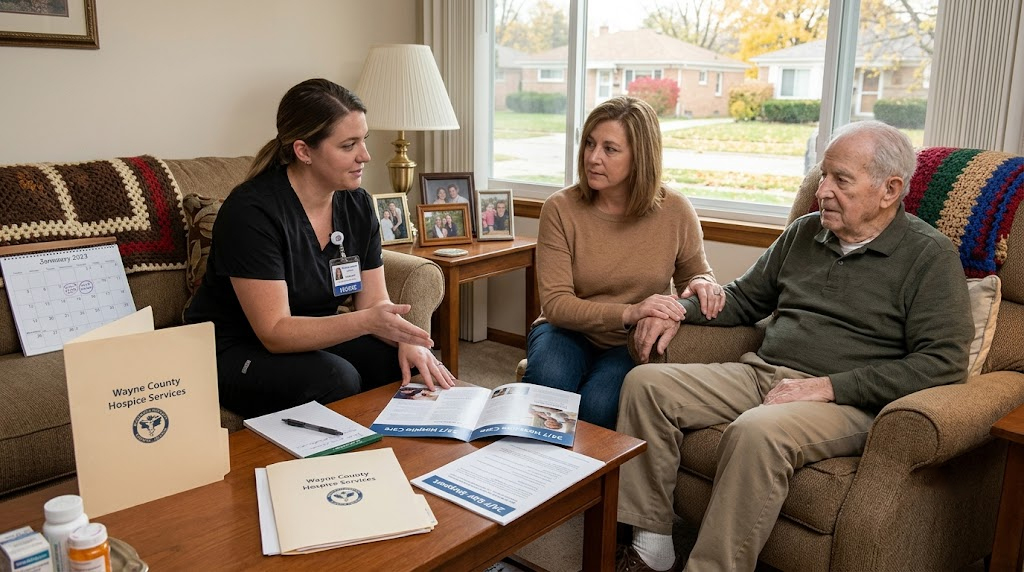
It’s 2 a.m. The house is quiet, except for your dad’s breathing. It sounds different tonight, faster and more labored. You’re standing in the hallway with your phone in your hand, heart pounding, wondering who you’re supposed to call.
If you’ve been in that hallway, or you’re afraid you will be, this guide is for you. Take a deep breath. You don’t have to carry these nights alone.
That’s when understanding what 24/7 hospice support really means can make a difference.
Medicare-certified hospice programs must provide access to nursing services 24 hours a day, including nights, weekends, and holidays. Families can contact their hospice team when symptoms or care needs change. However, 24/7 availability does not mean a nurse remains in the home continuously.
For families exploring in-home hospice care in Wayne County, Michigan, knowing how after-hours support works can bring greater clarity and confidence.
At T.O.N.E. Hospice & Palliative Care, we believe families deserve compassionate guidance, clear communication, and a better understanding of what to expect from hospice services. For 20 years, T.O.N.E. Hospice has helped Michigan families through nights like this one.
This guide explains how 24/7 hospice support works, when a nurse may visit, and how Medicare’s different levels of hospice care address changing needs.
What Does 24/7 In-Home Hospice Support Actually Mean?
One of the most common questions families ask is whether 24/7 hospice care means someone will be physically present in the home around the clock.
For most patients receiving routine hospice care, the answer is no.
24/7 hospice support means families have access to nursing assistance at any hour, even when the regular care team is not scheduled to visit.
Depending on the patient’s needs and the hospice’s established procedures, this support may include:
- Access to nursing guidance during evenings, weekends, and holidays
- Telephone assessment of new or changing symptoms
- Instructions consistent with the patient’s individualized care plan
- In-person nursing visits when clinically indicated
- Coordination with the hospice team when additional care is needed
- Evaluation for a different level of hospice care when symptoms require more intensive support
During routine hospice care, nurses, hospice aides, social workers, chaplains, and other professionals visit according to the patient’s care plan.
The hospice’s after-hours nursing support remains available between scheduled visits.
Understanding this distinction helps families prepare for care at home and ask the right questions before enrolling with a hospice provider.
Understanding Medicare’s Four Levels of Hospice Care
Medicare recognizes four levels of hospice care designed to address different patient and caregiver needs.
The appropriate level depends on the patient’s clinical condition, the type of support required, and applicable Medicare requirements.
| Level of hospice care | What it provides | Typical setting |
| Routine Home Care | Scheduled hospice services and access to nursing support between visits | Private home, assisted living, nursing home, or another residential setting |
| Continuous Home Care | Intensive nursing support during a qualifying short-term symptom crisis | Patient’s home or qualifying residential setting |
| General Inpatient Care | Short-term intensive symptom management when care cannot feasibly be provided in another setting | Appropriate inpatient hospice, hospital, or nursing facility |
| Inpatient Respite Care | Temporary inpatient care to provide relief for family caregivers | Medicare-approved inpatient facility |
1. Routine Home Care: Support in Familiar Surroundings
Routine home care is the most common level of hospice care.
The patient remains in their home or residential setting while the hospice team provides services according to an individualized care plan.
Depending on the patient’s needs, the care team may include:
- Registered nurses who assess symptoms and coordinate clinical care
- Hospice aides who assist with personal care
- Social workers who provide emotional and practical support
- Chaplains or spiritual care professionals, based on patient preferences
- Physicians and other appropriate healthcare professionals
Visit frequency is determined by the patient’s condition and care plan rather than a universal schedule.
Between visits, families have access to the hospice’s nursing support system.
Routine home care does not generally include a nurse remaining in the home throughout the day and night.
2. Continuous Home Care: Additional Support During a Symptom Crisis
Sometimes a patient develops acute symptoms that require more intensive nursing support to help them remain at home.
Examples may include severe pain or breathing-related discomfort that requires frequent clinical assessment and intervention.
In qualifying circumstances, the hospice may provide continuous home care.
Under Medicare requirements, this level generally involves:
- At least eight hours of care within a 24-hour period
- More than half of the care hours provided by nursing personnel
- Care delivered during a brief period of crisis
- A clinical need for intensive support to help maintain the patient at home
Continuous home care may involve registered nurses, licensed practical or vocational nurses, and hospice aides, as appropriate under Medicare requirements.
It is not the same as long-term private-duty nursing or routine overnight caregiving.
The hospice team evaluates whether the patient’s condition meets the criteria for this level of care.
3. General Inpatient Care: When Symptoms Need More Intensive Management
Some symptoms cannot be adequately managed in the patient’s home or residential setting.
When more intensive clinical management is necessary, general inpatient hospice care may be appropriate.
This level of care is provided in an eligible inpatient setting, such as a hospice inpatient unit, hospital, or appropriately qualified nursing facility.
The purpose is to address symptoms requiring inpatient management.
When the patient’s condition allows, care may transition back to a less intensive setting.
4. Inpatient Respite Care: Temporary Relief for Family Caregivers
Caregivers are human. Family caregiving is meaningful work, but it’s also physically and emotionally demanding, and everyone needs a break sometimes.
Medicare’s inpatient respite care benefit allows an eligible hospice patient to receive temporary care in an approved inpatient facility, giving the usual caregiver time to rest or attend to other responsibilities.
Respite care is generally limited to five consecutive days per respite stay, subject to applicable Medicare requirements.
Families should discuss eligibility, availability, and possible cost-sharing with their hospice provider.
For more information about hospice coverage and services, visit Medicare.gov.
What Happens When You Call Hospice in the Middle of the Night?
Imagine noticing that your loved one is more restless than usual or seems uncomfortable despite the care measures already in place.
You don’t have to wait until morning to ask for guidance.
Hospice providers establish after-hours procedures so families can reach nursing support when concerns arise.
Although the exact process varies by agency, an after-hours call generally involves the following steps.
Step 1: Contact Your Hospice’s After-Hours Number
Keep the hospice contact number somewhere easy to find, such as on the refrigerator and saved in your phone.
When you call, you may speak directly with a clinician or connect through an answering service that contacts the appropriate nursing professional.
A trustworthy hospice provider should explain its after-hours communication process before care begins.
Step 2: Explain What’s Happening
The nurse or other appropriate clinician may ask questions about your loved one’s symptoms.
For example:
- What changes have you noticed?
- When did the symptoms begin?
- Is your loved one experiencing pain or breathing discomfort?
- Have prescribed medications or comfort measures already been used?
- Are there any immediate safety concerns?
These questions help the clinician understand the situation and determine the appropriate next step.
Step 3: Receive Guidance Based on the Care Plan
Depending on the concern, the clinician may recommend an appropriate comfort measure already included in the patient’s care plan.
This could involve positioning, reviewing prescribed medication instructions, or taking another action appropriate to the patient’s needs.
Families should not change medication doses or administer unfamiliar medications without following the patient’s prescribed orders and hospice instructions.
Step 4: Arrange an In-Person Assessment When Needed
Some concerns can be addressed through telephone guidance.
Others require a nurse to assess the patient in person.
The hospice team determines whether a visit, additional medical evaluation, or another level of care is appropriate based on the patient’s condition.
Step 5: Coordinate Follow-Up Care
The hospice documents clinically relevant concerns and coordinates appropriate follow-up with the patient’s care team.
Depending on the situation, this may involve reassessing symptoms, reviewing the care plan, or arranging additional services.
The purpose of after-hours support is to help families understand what is happening and receive appropriate clinical guidance when their loved one’s needs change.
When Is Telephone Guidance Enough, and When Might a Nurse Visit?
Families sometimes wonder whether they should call hospice for a new symptom or wait until the next scheduled visit.
A useful principle is simple: If you are concerned about a change in your loved one’s condition, contact the hospice team for guidance.
The clinician can help determine the appropriate response.
Concerns That May Be Addressed by Telephone
Depending on the patient’s condition and existing care plan, telephone guidance may be appropriate for:
- Questions about prescribed medications
- Mild discomfort that responds to previously ordered care measures
- Changes in sleep or restlessness
- Questions about positioning or comfort
- Clarification of existing care instructions
Concerns That May Require In-Person Assessment
A nurse may need to visit when a patient experiences:
- Persistent or worsening pain
- Breathing discomfort that is not responding to the existing care plan
- Significant changes in condition
- New symptoms requiring clinical assessment
- Care needs that cannot be adequately evaluated or addressed by telephone
Falls, new bleeding, severe breathing problems, or sudden changes in responsiveness may require urgent medical evaluation.
The appropriate response depends on the situation and the patient’s individualized emergency care plan.
Should You Call Hospice or 911?
For non-emergency symptom changes, contact the hospice team using the number provided in your care instructions.
Families should discuss emergency planning with the hospice team before an urgent situation occurs, including when to call hospice and when emergency services may be necessary.
If there is an immediate life-threatening emergency and emergency medical assistance is needed, call 911.
Hospice care does not remove a patient’s right to emergency medical assistance. However, emergency treatment may affect hospice coordination and coverage, so families should understand their care plan and communicate with the hospice whenever possible.
What Is a Hospice Comfort Kit, and How Is It Used?
Some hospice programs provide an emergency medication kit, often called a comfort kit.
The kit may contain prescribed medications intended to address certain symptoms if they arise between scheduled visits.
Depending on the patient’s condition and care plan, medications may be prescribed for symptoms such as:
- Pain
- Nausea
- Anxiety or restlessness
- Breathing-related discomfort
- Other symptoms identified by the hospice physician
Not every patient receives the same medications, and some hospice programs use different medication-delivery arrangements.
How Should Families Handle a Comfort Kit?
The hospice team should explain which medications are included, when they may be used, how they should be administered, and how they should be stored.
Important precautions include:
Follow the prescribed instructions. Only administer medications according to the patient’s current orders and the instructions provided by the hospice team.
Store medications correctly. Follow each medication’s labeled storage requirements. Do not assume that all comfort-kit medications belong in the refrigerator.
Keep medications secure. Store them away from children, pets, and anyone who is not authorized to handle them.
Ask questions before administering unfamiliar medications. Contact the hospice team if instructions are unclear or symptoms have changed.
Follow safe disposal guidance. Ask the hospice or pharmacist how unused medications should be handled.
The purpose of a comfort kit is to make prescribed symptom-management medications accessible when they may be needed. It turns a frightening wait into a calmer, guided moment, as long as the right instructions are followed.
Families should receive clear education so they understand how the kit fits into their loved one’s care plan.
Six Questions to Ask About 24/7 Hospice Support in Wayne County
Not every hospice provider organizes after-hours services in exactly the same way.
Before choosing an agency, ask these questions to understand what your family can expect.
1. Who Answers Calls After Regular Business Hours?
Ask whether you will speak directly with a nurse or whether an answering service will connect you with the appropriate clinician.
The important consideration is how reliably and promptly clinical concerns are addressed.
2. How Are Urgent Home Visits Arranged?
Ask how the hospice determines whether an in-person visit is needed and how the team communicates expected arrival information.
Avoid assuming that all agencies follow the same response-time procedures.
3. What Happens if Symptoms Require More Intensive Care?
Ask how the hospice evaluates patients for continuous home care or general inpatient care when clinically necessary.
Understanding these options before a crisis can help families feel better prepared.
4. Will We Receive a Comfort Kit?
Ask whether the hospice provides prescribed emergency medications, how caregivers are trained to use them, and whom to contact with medication questions.
5. How Does the Daytime Team Learn About After-Hours Concerns?
Ask how nighttime calls and urgent assessments are documented and communicated to the regular care team.
Continuity of information is an important part of coordinated care.
6. How Often Will Nurses and Hospice Aides Visit?
Ask how the care plan determines visit frequency and what happens when your loved one’s needs change.
A quality hospice provider should welcome these questions and explain its procedures clearly, without making promises that cannot be guaranteed.
24/7 Hospice Support for Families in Wayne County, Michigan
Families throughout Wayne County want the same reassurance: that their loved one will receive compassionate care and that they will know where to turn when questions arise.
T.O.N.E. Hospice cares for families across the county, from Detroit’s historic neighborhoods to the quieter streets of Canton near I-275. We visit homes in Livonia and Redford along the I-96 corridor, in Dearborn and Dearborn Heights, and in Westland and Taylor, along with assisted living communities and nursing facilities throughout Wayne County.
Our care comes from our Farmington Hills office, and our team knows Wayne County’s roads and communities. Whether your loved one lives in a Detroit bungalow or a Livonia ranch home, the goal is the same: comfort, dignity, and a care team you can actually reach.
If you’re exploring hospice services in Wayne County, contact T.O.N.E. online to confirm availability in your community and learn how our after-hours support process works.
Frequently Asked Questions About 24/7 Hospice Care
Is hospice care available 24 hours a day?
Medicare-certified hospice programs must provide access to nursing services 24 hours a day, including weekends and holidays.
Families can contact their hospice team when symptoms or care needs change, even outside scheduled visit times.
Does a hospice nurse stay overnight?
Not usually during routine home hospice care.
Continuous home care may provide extended nursing support during qualifying short-term symptom crises, but it is not the same as permanent overnight nursing or private-duty caregiving.
What happens if my loved one has symptoms at night?
Contact the hospice’s after-hours number.
A qualified clinician can assess the concern, provide guidance based on the care plan, and arrange an in-person visit or additional evaluation when clinically appropriate.
Can a hospice nurse come to our home after hours?
Yes, hospice programs must have arrangements for nursing services to be available when needed.
Whether a visit is required depends on the patient’s condition and clinical assessment. Families should ask their provider about its specific after-hours procedures.
What is continuous home hospice care?
Continuous home care is a Medicare hospice level used during qualifying short-term periods of crisis requiring intensive nursing support.
It generally requires at least eight hours of care in a 24-hour period, with more than half provided by nursing personnel.
It is not routine 24-hour bedside care.
Does Medicare cover 24/7 hospice support?
For eligible patients who elect the Medicare Hospice Benefit, covered hospice-related nursing services, medications, equipment, and supplies are generally included according to the patient’s care plan and Medicare requirements.
Limited cost-sharing may apply for certain medications and inpatient respite care. Some expenses, such as routine room and board in residential facilities, are generally not covered by the hospice benefit.
Should I call hospice or 911?
For non-emergency symptom changes, contact your hospice team according to your care plan.
For an immediate life-threatening emergency requiring emergency medical assistance, call 911.
Discuss emergency planning with your hospice team in advance so your family understands the appropriate steps.
How do I find 24/7 hospice support in Wayne County?
Ask prospective hospice providers about nursing availability, after-hours calls, urgent visits, continuous home care arrangements, and service coverage in your community.
You can also contact T.O.N.E. Hospice & Palliative Care to ask about available services and next steps.
Compassionate Support, Day and Night
You deserve to know that when the house goes quiet and something changes, someone will pick up.
For 20 years, T.O.N.E. Hospice has helped Michigan families through nights like this one. Our licensed team of physicians, nurses, social workers, aides, chaplains, and bereavement coordinators is here to answer questions, take symptoms seriously, and help your family understand your options.
Without steady support, families often end up in the emergency room at 3 a.m., exhausted and scared. It doesn’t have to go that way.
Picture a different night. Dad’s breathing has eased. The lamp is low. His favorite music plays softly, and you’re sitting beside him, holding his hand, finally able to just be his daughter again.
Comfort for Your Loved One. Guidance for Your Family.
Call T.O.N.E. Hospice & Palliative Care at 248-522-9572, or reach out online, to discuss hospice services, after-hours support, and availability in your community.
T.O.N.E. Hospice & Palliative Care, Inc. 33742 W. 12 Mile Rd., Suite A2 Farmington Hills, MI 48331 Phone: 248-522-9572 Email: [email protected] Website: www.tonehospice.com Office Hours: Available 24/7 for patients and families; office hours Monday–Friday, 8:30 a.m.–5:00 p.m.
This article provides general educational information and does not replace individualized medical advice. Hospice care arrangements, response procedures, medication instructions, and insurance coverage depend on the patient’s condition, care plan, provider, and applicable program requirements. Contact your hospice team for guidance specific to your situation.